Choosing a cutting process affects edge quality, production speed, material use, and operating cost. This guide examines the top 10 differences between laser and mechanical cutting. The practical question is simple: what is the difference between laser cutting and mechanical cutting? The answer depends on material, thickness, geometry, tolerance, and production volume. A thin stainless-steel panel may leave a clean laser edge in seconds. A thick plate may require another solution. Real workshops understand this tension. No single method wins every time.
Laser cutting uses a focused beam and usually requires no physical tool contact. It can follow intricate profiles, create small holes, and reduce setup changes. Mechanical cutting uses blades, saws, punches, or other force-based tools. It often provides predictable results on heavier stock and familiar shop equipment. Yet tool wear, vibration, burrs, noise, and maintenance can influence the final part. These details matter when operators inspect edges under bright task lighting. A smooth appearance alone does not prove better performance. Fit, heat effects, repeatability, and total cost deserve equal attention.
This comparison follows accepted fabrication principles and practical production considerations. It considers accuracy, speed, flexibility, material compatibility, safety, waste, maintenance, and finish quality. Manufacturer data remains essential for final decisions. Shop experience also matters. Variables are easy to underestimate. Laser settings need careful control of power, focus, assist gas, and travel speed. Mechanical tools need correct clearance, alignment, and cutting pressure. The comparison is not perfectly universal. That limitation should remain visible. By weighing these ten differences against real job requirements, engineers and buyers can choose more confidently.
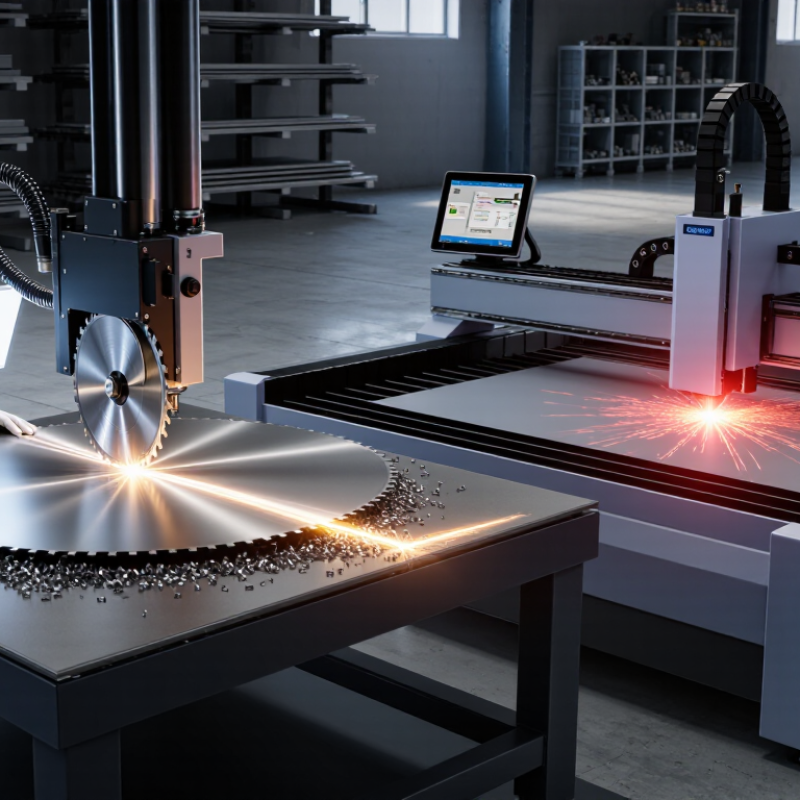
Laser cutting uses a focused beam to heat, melt, or vaporize material along a programmed path. Assist gas pushes molten metal away from the cut. A CNC system controls movement, speed, and beam power. The result is usually a narrow kerf, often around 0.1–0.4 millimeters, depending on material and settings.
Mechanical cutting works through direct force. A blade, saw, shear, or punch physically removes or separates material. Teeth create chips, while shears deform the sheet before breaking it. It can cut thick sections effectively, but tool contact creates friction, vibration, and gradual wear. The cut is physical. Heat remains lower, although friction can still affect the edge. ISO 9013 provides a useful framework for evaluating thermal-cut edge quality, while practical results depend heavily on operator experience. A 2024 industrial energy analysis from the International Energy Agency places industry near 37% of global final energy use, so cutting efficiency deserves attention, not just speed.
Tips: Choose laser cutting for intricate profiles, small holes, and reduced secondary finishing. Choose mechanical cutting when thickness, simplicity, or lower equipment cost matters most. Check kerf compensation before programming. Inspect burrs, edge squareness, and heat-affected zones after the first test cut. Real workshops rarely behave perfectly; reflective metals, worn tooling, unstable gas pressure, and incorrect feeds can change the expected result. That is where careful measurement beats assumptions.
Laser cutting often produces tighter profiles because the beam removes little material. A narrow kerf helps preserve small holes, sharp corners, and detailed patterns. In shop trials, well-calibrated equipment can hold close tolerances on thin sheet metal. However, heat may create a slight heat-affected zone, discoloration, or edge taper. Reflective materials can also reduce cutting consistency.
Mechanical cutting removes material through physical contact. Shearing can create clean, straight edges on suitable sheet thicknesses, while milling or sawing offers control for thicker sections. Tool pressure may cause burrs, distortion, or minor movement during cutting. As tools wear, edge quality can decline before the defect becomes obvious. That point deserves more attention. Mechanical cutting is not automatically less accurate; fixturing, tool condition, feed rate, and operator skill matter greatly.
Tips: Compare finished samples, not only machine specifications. Measure hole diameter, corner shape, burr height, and perpendicularity. Check both sides of the edge under bright light. For laser work, inspect heat marks and taper. For mechanical work, inspect burr direction and surface tearing. Use slower feeds only when testing carefully, because excessive heat or friction can worsen the edge. A small trial panel is usually more reliable than an assumption based on material type alone.
Laser and mechanical cutting differ most when material compatibility and thickness limits become critical. Laser cutting suits carbon steel, stainless steel, aluminum, copper, and many coated sheets. However, reflective metals can reduce efficiency and increase setup demands. Mechanical methods, including sawing, shearing, and milling, handle reflective metals more comfortably. They also work well with thick plate, composites, and materials that react poorly to heat.
For thin and medium sheet, lasers usually provide narrow kerfs, low contact force, and precise small features. Typical fiber-laser ranges extend from about 0.5 mm to 25 mm in carbon steel, depending on power and gas control. Mechanical cutting can exceed 100 mm, especially with sawing or oxyfuel-based processes. These figures are practical ranges, not guarantees. ISO 9013:2017 links thermal-cut quality to material thickness and process settings. The World Steel Association’s 2024 World Steel in Figures reports 1.89 billion tonnes of crude steel production in 2023, showing why steel thickness remains a major fabrication concern. The boundary is not clean. Surface scale, internal stress, and poor nesting can change the result.
Tips: Confirm the actual grade, reflectivity, hardness, and thickness before choosing equipment. Request a test cut. Measure burr height and heat-affected zones, not just cutting speed. A fast cut may still produce costly edge cleanup. For thick plate, mechanical cutting may be slower but more predictable. For thin stainless parts, laser processing often reduces secondary finishing. Recheck the supplier’s capacity chart; published limits sometimes assume ideal material and laboratory conditions.
Top 10 Differences Between Laser and Mechanical Cutting?
Production speed depends heavily on material thickness, batch size, and setup time. Laser cutting often wins on thin sheet because it moves quickly between intricate profiles. Digital files can change without replacing tooling. Mechanical cutting may be faster for repeated straight cuts, especially in thick plate. Its process is familiar, but blade changes and fixture adjustments can slow production. There is no universal winner.
Laser systems offer strong flexibility for prototypes and short production runs. A single machine can cut holes, slots, curves, and detailed contours with minimal physical contact. Mechanical cutting usually needs dedicated tools, clamps, or multiple operations. That extra preparation may reduce efficiency when designs change frequently. In shop-floor planning, I have seen small drawing revisions disrupt a mechanical workflow. That weakness is easy to underestimate.
Design capability is another clear difference. A focused laser beam can create narrow kerfs and tight internal features, leaving more usable material. Mechanical tools may struggle with sharp corners, delicate webs, or sudden direction changes. However, laser heat can affect certain alloys, coatings, and thin sections. Mechanical cutting avoids a heat-affected zone, yet it can create burrs, vibration marks, or tool deflection. Engineers should test the actual material, not rely only on catalog tolerances. My own assessment would remain cautious: the fastest method on paper can perform poorly after inspection, cleanup, and rejected parts are counted.
Typical industrial comparison; actual results depend on material, thickness, machine configuration, tooling, and production conditions.
| No. | Comparison Dimension | Laser Cutting | Mechanical Cutting | Production and Design Impact |
|---|---|---|---|---|
| 1 | Cutting Principle | A focused laser beam melts, vaporizes, or burns through the material, while assist gas removes the molten material. | A physical tool, blade, saw, drill, or abrasive wheel removes material through contact and mechanical force. | Laser cutting is non-contact and reduces tool-workpiece contact; mechanical cutting applies cutting forces that may require stronger workholding. |
| 2 | Production Speed | Often provides high cutting speeds for thin sheet and small, repeated features. Modern systems can move at several meters per minute, although actual cutting speed depends heavily on material and thickness. | Can be faster for thick stock, simple straight cuts, or operations such as sawing and shearing. Speed is affected by tool diameter, feed rate, cutting force, and tool condition. | Laser is frequently advantageous for detailed sheet-metal profiles, while mechanical methods may be more productive for high-volume straight cuts or very thick sections. |
| 3 | Material Thickness | Commonly used for thin and medium-gauge sheet and plate. Cutting capacity decreases as thickness increases, and thick materials may require slower speeds or multiple process passes. | Often handles a wider range of thick materials, depending on the machine type and tooling. Saws, waterjets, mills, and abrasive processes can be selected for heavy sections. | Mechanical cutting is often preferred for very thick stock; laser cutting is usually efficient for thin-to-medium sheet production. |
| 4 | Design Flexibility | Creates complex profiles, internal holes, narrow slots, sharp transitions, and intricate patterns directly from a digital drawing without custom cutting tools. | Can produce complex parts, but the design may require multiple tools, setups, operations, or specialized fixtures. | Laser cutting generally supports faster design changes and more economical short-run or customized production. |
| 5 | Dimensional Accuracy | Modern industrial laser systems commonly achieve positioning accuracy in the range of approximately ±0.05 to ±0.15 mm, depending on machine condition and process settings. | Accuracy varies widely: precision CNC machining can achieve very tight tolerances, while sawing or manual cutting generally provides less precision. | Laser is highly accurate for profile cutting, but mechanical machining remains preferable when the part requires tight three-dimensional tolerances or precision finishing. |
| 6 | Edge Quality and Kerf | Produces a narrow kerf, often approximately 0.1–0.5 mm depending on the material and process. Edges are usually clean, but heat-affected zones, dross, or discoloration may occur. | Kerf depends on the tool width and cutting method. Edges may be burr-free in some shearing operations but can show burrs, tool marks, or surface roughness in sawing and milling. | Laser cutting minimizes material loss and often reduces secondary deburring, while mechanical cutting may provide a colder edge with different surface characteristics. |
| 7 | Heat and Material Distortion | Uses concentrated heat and can create a heat-affected zone, localized hardening, oxidation, or thermal distortion if heat input is excessive. | Most mechanical processes do not create a significant heat-affected zone, although friction, tool wear, and cutting fluid can still generate heat. | Mechanical cutting is often selected when thermal effects could affect material properties or dimensional stability. |
| 8 | Tooling and Changeover | Usually requires no dedicated profile tool. Program changes can be made digitally, and changeover is often short when material and thickness remain compatible. | May require tool selection, tool changes, fixtures, dies, guides, or setup adjustments for different geometries and materials. | Laser cutting reduces tooling inventory and is particularly flexible for prototypes, engineering changes, and mixed-part production. |
| 9 | Operating and Consumable Costs | Requires electricity, optics maintenance, assist gas, extraction, and periodic replacement of nozzles or protective components. Operating cost rises with power, thickness, and gas consumption. | Uses cutting tools, blades, inserts, abrasives, lubricants, and sometimes coolant. Tool wear and replacement frequency depend on material and cutting conditions. | Laser can reduce tooling costs but may require higher equipment investment and process infrastructure; mechanical equipment can be economical for simple, repetitive cuts. |
| 10 | Automation and Digital Workflow | Integrates readily with CAD/CAM software, nesting, automatic material handling, part identification, and robotic or multi-axis production cells. | CNC mechanical systems can also be highly automated, but automation may require additional tooling, fixtures, probing, or process-specific programming. | Laser cutting is especially suitable for digitally driven batch production and rapid design-to-part workflows; mechanical cutting remains highly effective for standardized operations. |
Note: “Mechanical cutting” includes sawing, milling, shearing, drilling, routing, and abrasive cutting. Performance, cost, and achievable tolerances vary substantially among these methods.
Top 10 Differences Between Laser and Mechanical Cutting: Operating Costs, Maintenance, and Workplace Safety
Laser cutting usually reduces tool-contact costs. There are no blades to sharpen, replace, or lubricate. However, electricity, assist gases, lenses, filters, and extraction systems add recurring expenses. The U.S. Department of Energy identifies process energy and compressed gases as important manufacturing cost factors. Mechanical cutting can appear cheaper initially, but blades, coolant, chips, and machine downtime gradually increase its operating cost. The real answer depends on material thickness, production volume, and energy prices.
Maintenance feels different on the shop floor. Laser operators clean optics, inspect nozzles, and check beam alignment. Mechanical operators monitor blade wear, vibration, coolant quality, and guarding. A neglected lens can distort a clean edge quickly. A worn blade can create heat, burrs, and unexpected movement. It is easy to underestimate cleaning time. That mistake is expensive. U.S. Bureau of Labor Statistics data records roughly three nonfatal workplace injuries per 100 full-time manufacturing workers, showing why maintenance and training matter.
Tips: Track cost per finished part, not hourly machine cost. Record gas use, blade changes, filter replacement, setup time, and rejected parts. Keep extraction airflow visible through scheduled inspections. OSHA machine-guarding guidance recommends preventing contact with moving parts, while laser safety standards emphasize controlled access and trained personnel. A laser enclosure may reduce exposure, but it does not remove every risk. Mechanical cutting needs secure workholding and chip control. Small workshops often discover this late.
Operating Costs, Maintenance, and Workplace Safety
This representative engineering benchmark uses a 1–5 relative burden index, where 1 indicates a lower burden and 5 indicates a higher burden. Laser cutting generally produces less noise, debris, and routine maintenance, while mechanical cutting avoids heat-affected zones and can be more suitable for materials sensitive to thermal distortion. Actual results depend on material, thickness, machine configuration, production volume, and local safety requirements.
Laser cutting suits carbon steel, stainless steel, aluminum, copper, and many coated sheets. Reflective metals may reduce efficiency and require careful setup. Test the actual material grade before production.
Mechanical cutting often handles plates above 25 millimeters more predictably. Sawing and similar processes can exceed 100 millimeters. It may be slower, but thick edges can remain more consistent.
Fiber lasers commonly cut carbon steel from about 0.5 to 25 millimeters. Results depend on power, gas control, material condition, and machine settings. Published limits are not guarantees.
Laser cutting often moves quickly through thin sheets with holes, curves, and narrow slots. Digital files allow design changes without replacing physical tools. Speed can fall when thick material or extensive cleanup is involved.
Mechanical methods can be efficient for repeated straight cuts, especially in thick plate. They may need blades, clamps, fixtures, or several operations. Setup changes can become inconvenient.
Laser cutting usually creates narrow kerfs and precise internal details. It can preserve more material around delicate sections. Heat may affect some alloys, coatings, or thin areas.
Compare electricity, assist gases, lenses, filters, extraction, blades, coolant, and downtime. Track the cost per finished part. A cheaper hourly rate may hide rejected parts and edge cleanup.
Laser systems need clean optics, inspected nozzles, and controlled access. Mechanical machines need sharp blades, secure workholding, guarding, and chip control. Small mistakes can cause injuries or poor edges. Training matters. Recheck the process.
Laser cutting and mechanical cutting use different methods to remove material. Laser cutting relies on a focused heat beam to melt or vaporize material, while mechanical cutting uses physical tools such as blades, saws, or milling cutters. The question “what is the difference between laser cutting and mechanical cutting” involves more than the cutting method alone. Laser systems generally provide higher precision, smoother edges, and greater flexibility for intricate shapes, whereas mechanical cutting can be effective for thicker or tougher materials and may offer strong physical control during processing.
The two methods also differ in material compatibility, thickness limits, production speed, and design capability. Laser cutting is often efficient for detailed patterns, rapid changes, and low-contact processing, while mechanical cutting can be practical for straightforward cuts and certain heavy-duty applications. Operating costs depend on equipment, energy use, tooling, maintenance, and material waste. Laser systems may require specialized upkeep, whereas mechanical tools need regular replacement or sharpening. Workplace safety for both methods depends on proper training, protective equipment, ventilation, machine guarding, and disciplined operating procedures.

Focus Laser